
Case Study - Architecting a Governance-First AI Operations Layer
Designing and deploying a production AI system that improved reliability, visibility, and operational control across fragmented workflows.
- Client
- BeeNex
- Year
- Service
- AI Infrastructure, Governance Design

Executive Summary
A multi-system organization was struggling with fragmented knowledge, manual triage workflows, and limited executive visibility. AI adoption was stalled due to governance concerns and lack of auditability.
BeeNex designed and deployed a structured AI operations layer that centralized knowledge, introduced deterministic routing, enforced role-based permissions, and embedded observability at every level.
The result: a trusted AI system engineered for production - not experimentation.
The Environment
The organization operated across CRM systems, project management tools, support platforms, shared document repositories, and internal SOP libraries. Data was distributed. Workflows were manual. Reporting required human synthesis.
Leadership lacked a reliable, system-level view of operational health.
The Challenge
AI interest existed internally, but adoption was blocked by:
- Fragmented data sources
- Inconsistent workflow ownership
- Manual triage and routing
- No traceability for AI-generated outputs
- Governance and compliance risk
- Lack of structured monitoring
The organization did not need a chatbot. It needed a controlled intelligence layer.
Phase 1 - Architecture Design
BeeNex approached the problem from the architecture layer downward.
We mapped sources of truth, workflow states and transitions, high-risk decision points, required approval gates, data boundary constraints, and reporting blind spots.
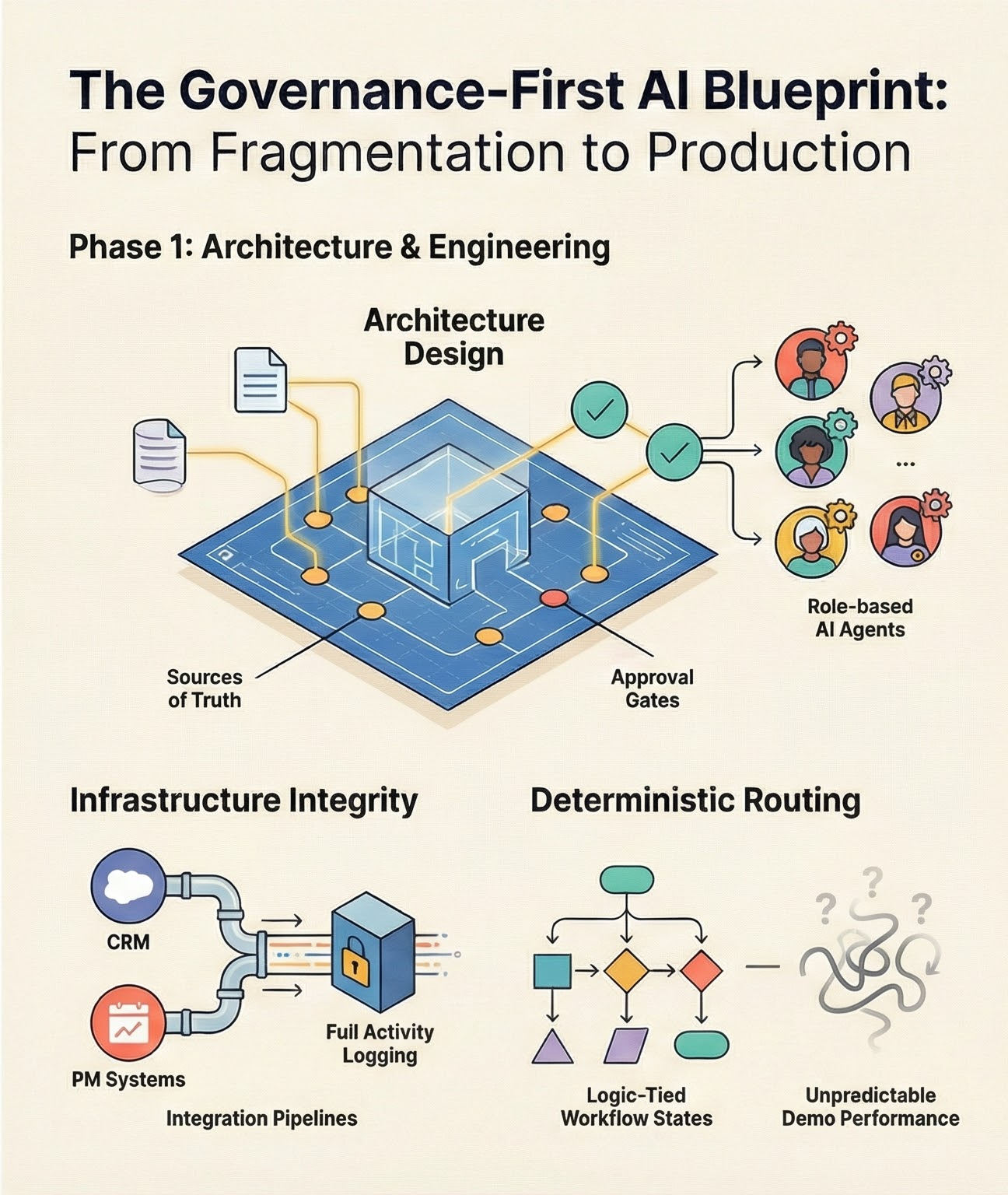
From this, we designed:
- A centralized retrieval layer with citation and boundary enforcement
- Deterministic routing logic tied to workflow state
- Role-based AI agents with defined capabilities
- Human-in-the-loop escalation controls
- Full logging and audit trail design
- Executive visibility layer for structured summaries
Phase 2 - Infrastructure Engineering
With the architecture defined, the system was engineered for production integrity.
- Backend Orchestration
- Integration Pipelines
- Retrieval & Embeddings
- Tool-Calling Framework
- Activity Logging
- Secure Deployment
Implementation included integration pipelines across CRM, PM, and support systems, a structured embedding and retrieval pipeline, a tool-calling framework with permission enforcement, retry logic and failure containment design, and activity logging and traceability infrastructure.
Every AI interaction was logged. Every automated action was traceable. Every workflow state was observable.
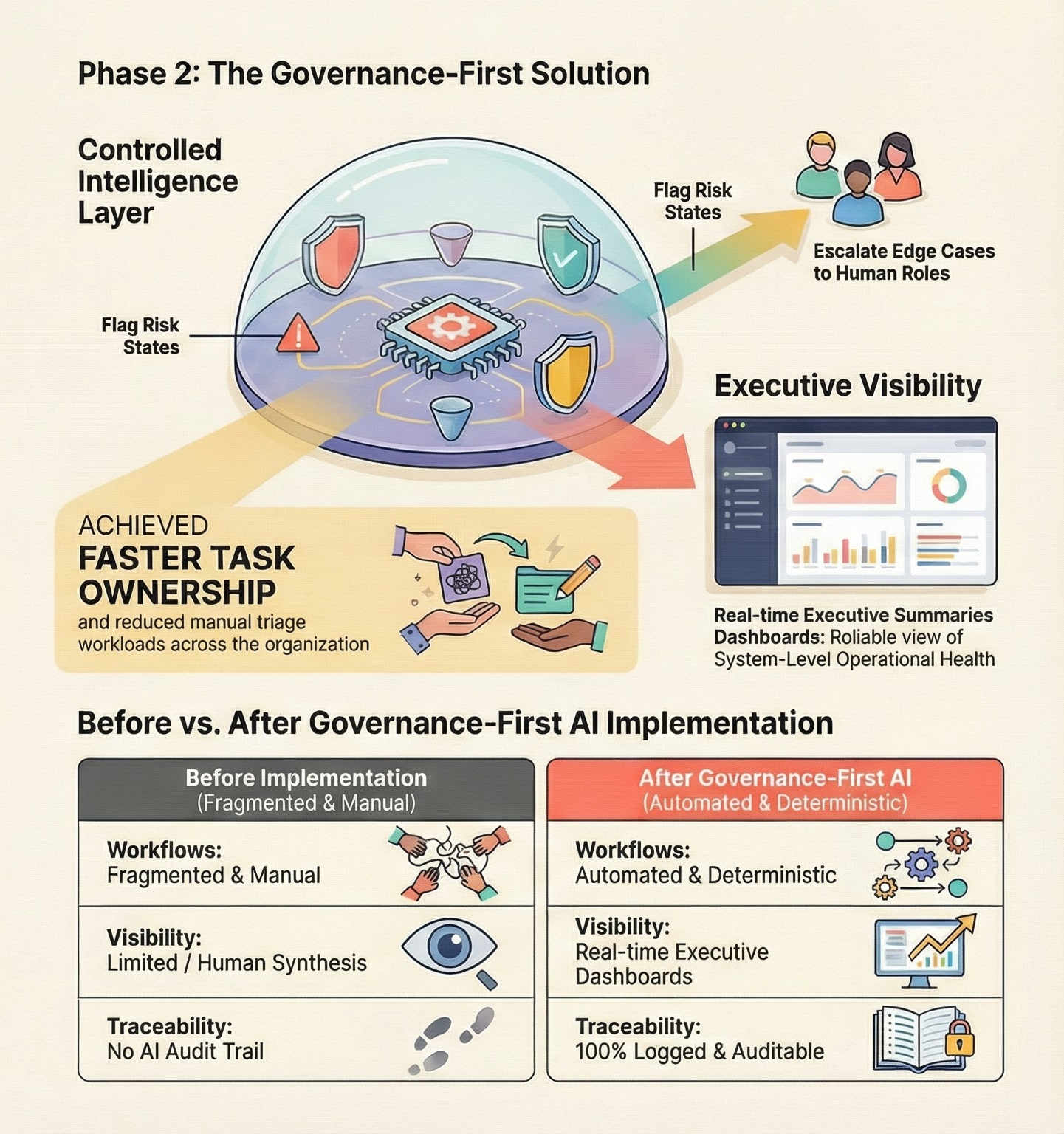
The system was built for deterministic behavior - not demo performance.
The Solution
BeeNex deployed a governance-first AI operations layer that:
- Retrieves trusted knowledge with source citation
- Routes requests automatically based on structured logic
- Flags risk states before escalation
- Logs AI-assisted decisions for review
- Escalates edge cases to designated human roles
- Generates executive summaries with contextual grounding
- Surfaces workflow bottlenecks in real time
Outcomes
- Manual triage workload
- Reduced
- Routing & task ownership
- Faster
- AI activity logging
- Auditable
- Leadership visibility
- Increased
AI moved from experimentation to controlled infrastructure. Trust in AI-assisted outputs increased. Governance safeguards enabled broader adoption across departments.
Reliable AI is not built at the interface layer. It is engineered at the system layer.